

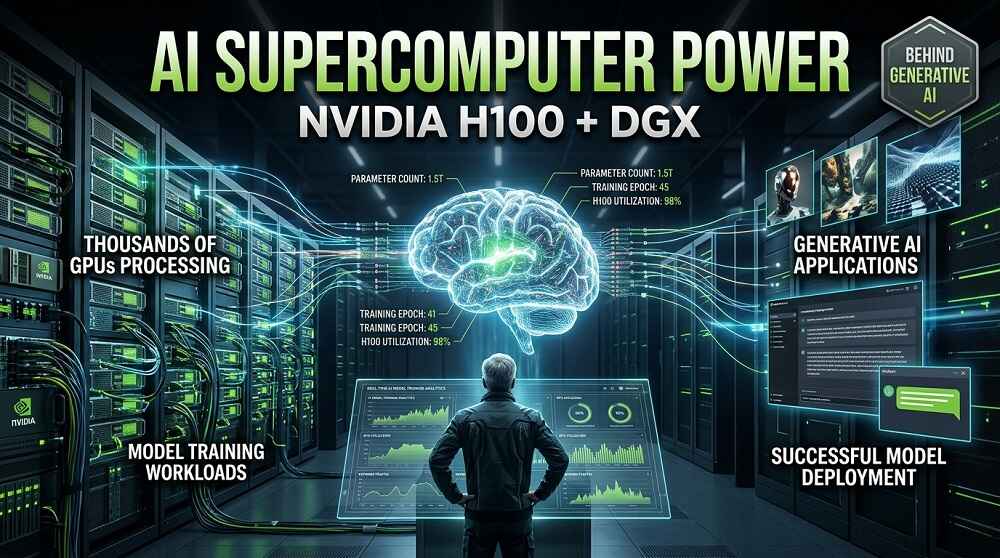
Have you ever wondered what actually runs the AI tools you use every day? When you generate a stunning image or create a video from a simple text prompt using tools like the ones on VeoAI Free, there is a massive amount of computing power working silently behind the scenes. Most people never think about it. But the HARDWARE behind modern generative AI is just as fascinating as the AI itself.
Let us break it all down.
What Is Generative AI, Really?
Generative AI refers to systems that can CREATE new content, whether that is text, images, audio, or video, based on patterns learned from enormous datasets. Tools like image generators and video generators have become widely accessible, but running them requires an incredible amount of PARALLEL COMPUTING POWER.
So where does that power come from? Two words: NVIDIA GPUs.
And not just any GPUs. We are talking about the NVIDIA H100 and the NVIDIA DGX family of supercomputers.
The NVIDIA H100: A Beast in Every Sense
The NVIDIA H100 Tensor Core GPU is, without exaggeration, one of the most powerful chips ever made for AI workloads. It was built with one goal in mind, and that is to accelerate AI training and inference at a scale that was simply not possible before.
Key Specifications of the NVIDIA H100
| Feature | H100 SXM5 | H100 PCIe |
|---|---|---|
| GPU Architecture | Hopper | Hopper |
| CUDA Cores | 16,896 | 14,592 |
| Tensor Core Generation | 4th Gen | 4th Gen |
| GPU Memory | 80 GB HBM3 | 80 GB HBM2e |
| Memory Bandwidth | 3.35 TB/s | 2 TB/s |
| FP8 Tensor Performance | 3,958 TFLOPS | 3,026 TFLOPS |
| NVLink Bandwidth | 900 GB/s | N/A |
| Transformer Engine | Yes | Yes |
Why does this matter? Because training a large AI model, like the ones that power image generation or video synthesis, requires handling BILLIONS of parameters simultaneously. The H100 makes this possible at speeds that earlier hardware could not dream of.
The Transformer Engine: A Game Changer
One of the most important features of the H100 is its Transformer Engine. This is a purpose-built component designed specifically to accelerate transformer-based models, which is the foundational architecture behind nearly every modern generative AI system.
The Transformer Engine uses FP8 PRECISION automatically, switching between 8-bit and 16-bit floating point calculations on the fly. This means you get faster training and lower memory usage without sacrificing model accuracy. It is clever engineering, really.
What Is the NVIDIA DGX System?
Now, a single H100 GPU is impressive. But what happens when you need to train a MASSIVE model with hundreds of billions of parameters? That is where the NVIDIA DGX supercomputing systems come in.
Think of DGX as a fully integrated AI supercomputer. It is not just a server with some GPUs thrown in. It is an optimized, purpose-built system where every component, from the CPUs to the network fabric, is designed to maximize AI performance.
The NVIDIA DGX H100
The DGX H100 is the latest and most powerful system in NVIDIA’s DGX lineup. Here is what makes it stand out:
- 8x NVIDIA H100 SXM5 GPUs in a single system
- 640 GB of combined GPU memory across all 8 GPUs
- NVLink and NVSwitch interconnects for ultra-fast GPU-to-GPU communication
- InfiniBand networking for connecting multiple DGX nodes together
- 2x Intel Xeon CPUs and 2 TB of system RAM
- 30 TB of NVMe storage for fast data access during training
The result? A single DGX H100 system can deliver up to 32 petaFLOPS of FP8 AI performance. That is a number so large it is hard to even visualize.
DGX SuperPOD: When One Is Not Enough
For truly large-scale AI training, companies deploy multiple DGX systems in what NVIDIA calls a DGX SuperPOD. A SuperPOD can connect hundreds of DGX nodes through a high-speed network fabric, creating a distributed AI supercomputer capable of training models with TRILLIONS of parameters.
This is the kind of infrastructure that tech giants like Google, Microsoft, and Meta use to train their foundational models. The scale is almost absurd.
Why Does This Hardware Matter for Generative AI?
Good question. Let us connect the dots.
When you use an AI image generator to create artwork from a text prompt, here is a simplified version of what happens:
- Your text prompt is tokenized and passed through an encoder
- A diffusion model runs multiple denoising steps, each requiring thousands of matrix multiplications
- A decoder converts the latent representation into pixel values
- The final image is returned to you
Each of those steps involves MASSIVE matrix operations. A single image generation inference can require billions of floating point operations. Now imagine thousands of users doing this simultaneously. The only way to handle this is with hardware like the H100.
For VIDEO generation specifically, the compute requirements multiply dramatically. Generating a few seconds of video can require 10 to 100 times more compute than generating a single image, because you are essentially generating many frames and maintaining temporal consistency across them.
Training vs Inference: Two Different Challenges
It is worth noting that AI hardware is used in two distinct phases.
Training is where the model learns from data. This is the most computationally expensive phase. Training a large diffusion model might require hundreds of H100 GPUs running continuously for weeks or months.
Inference is where the trained model is actually used to generate outputs. This is what happens when you use an AI video generator to create content. Inference is faster per request, but the volume of requests at scale still demands serious GPU power.
| Phase | Purpose | Hardware Scale | Duration |
|---|---|---|---|
| Training | Model learns from data | Hundreds to thousands of GPUs | Weeks to months |
| Fine-Tuning | Adapts model for specific tasks | Tens to hundreds of GPUs | Days to weeks |
| Inference | Generates outputs for users | Varies by traffic | Real-time |
The Role of NVLink and NVSwitch
One thing that makes the DGX H100 so powerful is not just the individual GPUs, it is how they communicate with each other.
NVLink is NVIDIA’s proprietary high-speed interconnect that allows GPUs to share data directly at 900 GB/s. This is critical because during training, GPUs need to constantly synchronize their parameter updates. If the interconnect is slow, the GPUs spend more time waiting than computing.
NVSwitch takes this a step further by creating an all-to-all mesh topology across all 8 GPUs in a DGX system. Every GPU can communicate with every other GPU at full speed simultaneously. There is no bottleneck.
This architecture is why a DGX H100 is fundamentally more capable than just putting 8 random GPUs in a server. The whole system is engineered as one coherent unit.
The Energy and Cooling Challenge
Let us be honest about something. These systems consume enormous amounts of power.
A single DGX H100 system draws up to 10.2 kilowatts of power under full load. A DGX SuperPOD with 32 nodes would draw over 300 kilowatts. Data centers running thousands of these systems are consuming megawatts of power.
This is why NVIDIA has invested heavily in LIQUID COOLING solutions for the H100 and DGX systems. Air cooling is simply not sufficient for this level of thermal density. Direct liquid cooling, where coolant is circulated directly over the GPU and other hot components, is increasingly standard in large AI deployments.
The energy cost is real, and it is one of the major factors driving research into more efficient model architectures and inference optimizations.
How NVIDIA’s Software Stack Amplifies the Hardware
Hardware alone is only half the story. NVIDIA’s software ecosystem, particularly CUDA, cuDNN, and the NVIDIA AI Enterprise platform, is what allows developers to actually harness this hardware effectively.
CUDA is NVIDIA’s parallel computing platform and programming model. It allows developers to write code that runs directly on the GPU, taking advantage of its thousands of cores. cuDNN provides highly optimized primitives for deep learning operations like convolutions and matrix multiplications.
Without this software stack, even the most powerful hardware would be difficult to use effectively. NVIDIA has spent decades refining these tools, which is a big part of why their hardware remains dominant in AI workloads.
What Does This Mean for the Future of AI Tools?
The rapid advancement of hardware like the H100 and DGX systems is directly enabling the AI tools that are becoming part of everyday creative and professional workflows. The gap between what is possible in research labs and what is accessible to regular users is closing fast.
As inference hardware becomes more efficient and as new GPU architectures push performance even higher, we can expect AI generation tools to become faster, more capable, and more widely accessible. Tasks that today require expensive cloud infrastructure may eventually run on consumer hardware.
It is a genuinely exciting time to be watching this space.
Final Thoughts
The NVIDIA H100 and DGX supercomputers are not just incremental upgrades over previous hardware. They represent a fundamental leap in the kind of AI work that is now possible. From training trillion-parameter models to serving millions of inference requests in real time, this hardware is the foundation upon which the modern generative AI ecosystem is built.
Next time you generate an image or create a video using an AI tool, spare a thought for the silicon powering it all. The results might feel like magic, but the engineering behind it is very real, and very impressive.