

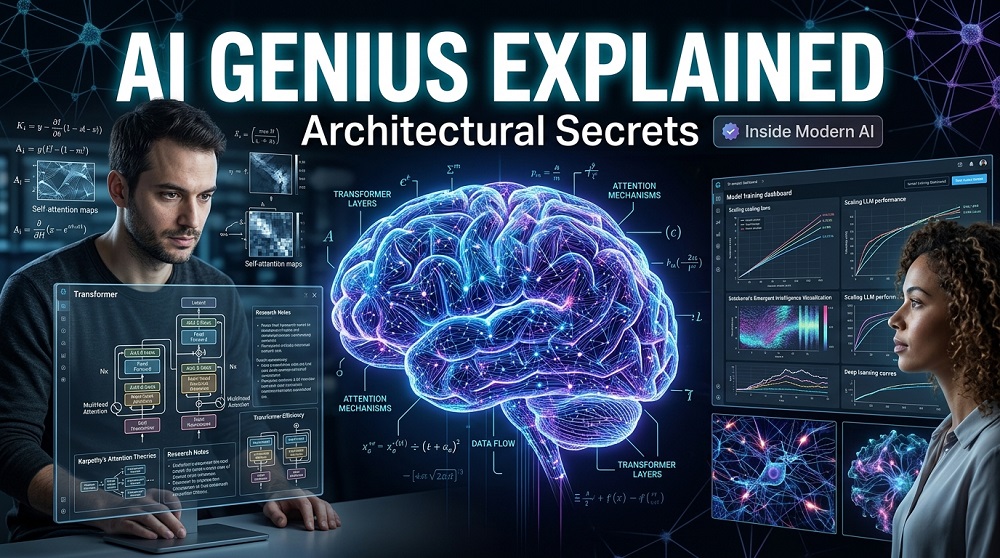
Artificial intelligence has moved fast in the last decade. But behind the breakthroughs, there are people. Real thinkers who spent years trying to understand how machines can learn. Two names that keep coming up in these conversations are Andrej Karpathy and Ilya Sutskever. Both played a huge role at OpenAI. Both have contributed ideas that are still shaping how we build AI systems today.
So what exactly did they figure out? And why does it still matter in 2025?
Let’s break it down.
Who Are These Two People, Really?
Before we get into the theories, its worth knowing a little bit about who we are talking about.
Andrej Karpathy studied under Fei-Fei Li at Stanford, where he worked deeply on computer vision and recurrent neural networks. He later became the Director of AI at Tesla before rejoining OpenAI. He is known for making complex ideas simple. His lectures, GitHub repositories, and blog posts have educated thousands of engineers worldwide.
Ilya Sutskever is a co-founder of OpenAI and was its Chief Scientist for many years. He studied under Geoffrey Hinton at the University of Toronto, one of the GODFATHERS of deep learning. Sutskever co-invented the sequence to sequence (Seq2Seq) model with Google Brain, which became the foundation of modern translation and language models. He later founded Safe Superintelligence Inc. in 2024 after leaving OpenAI.
Both of them have a way of seeing things that others miss. And that is what makes their architectural theories worth studying.
The Core Architectural Ideas They Championed
1. The TRANSFORMER Architecture and Scaling Laws
One of the most important theoretical contributions connected to both researchers is the understanding of how TRANSFORMERS scale.
Sutskever was among the early believers that simply making models bigger, with more parameters and more data, would lead to dramatically better performance. This idea became known as the SCALING HYPOTHESIS. At the time, many researchers thought it was too simplistic. Why would just adding more compute and data work so well?
But it did. And it keeps working.
The key insight was that TRANSFORMER architectures, which rely on the ATTENTION MECHANISM, have a very efficient way of capturing relationships between tokens in a sequence. Unlike RNNs which process things one step at a time, Transformers can look at everything at once. This parallelism is what made scaling practical.
Why does scaling work so well with Transformers? Because attention is fundamentally about routing information. More parameters means finer grained routing. And finer routing means better understanding.
Karpathy has been particularly vocal about this in his public talks. He has said that NEURAL NETWORKS do not need to be hand-designed. The architecture itself, given enough scale and data, will find the right internal representations.
2. Karpathy’s Theory of the “SOFTWARE 2.0” Paradigm
This is one of Karpathy’s most original and important ideas. He wrote about it in a widely shared 2017 blog post titled Software 2.0.
The central argument is simple but profound. In traditional programming (SOFTWARE 1.0), humans write explicit instructions. In SOFTWARE 2.0, the instructions are learned from data. Neural networks are not just tools. They are a new way of writing software.
What does this mean for architecture?
It means that instead of designing every rule by hand, the job of the engineer is to:
- Define the problem through the dataset
- Choose the right architecture to allow learning
- Set the loss function to guide optimization
- Let the network figure out the rest
This has massive implications. It shifts the focus from algorithm design to DATA CURATION and ARCHITECTURE SELECTION.
Karpathy argued that most of the code we write today will eventually be replaced by learned models. The software stack itself is being rewritten from the inside out.
If you want to understand what this looks like in practice, tools like AI image generators and video generators are already living examples of Software 2.0. Models like Stable Diffusion or Sora do not follow hand-written rules for creating visuals. They learn the structure of images and videos from data. You can actually explore these kind of AI tools at veoaifree.com to see this philosophy in action.
3. Sutskever and the SEQUENCE TO SEQUENCE Framework
Before Transformers dominated, Sutskever and his co-authors introduced a framework that changed everything: Seq2Seq with encoder-decoder architecture.
The idea was elegant. Two neural networks working together:
| Component | Role |
|---|---|
| Encoder | Reads the input sequence and compresses it into a fixed context vector |
| Decoder | Takes that context vector and generates the output sequence |
This was the architecture behind early Google Translate. It proved that neural networks could handle variable length inputs and outputs, which was a huge problem before this.
But Sutskever himself identified a flaw. The fixed-size context vector was a bottleneck. No matter how long the input was, everything had to fit into one vector. This led to the development of ATTENTION MECHANISMS, which eventually became the foundation of the Transformer architecture.
So in a way, Sutskever’s work on Seq2Seq planted the seed of its own successor.
4. The Role of PRETRAINING and Self-Supervised Learning
Both researchers deeply believe in the power of PRETRAINING. The idea is that before you train a model on a specific task, you train it on a massive amount of general data first.
Why? Because the model learns general representations of the world. Language structure. Visual patterns. Logical relationships. Then when you fine-tune it for a specific task, it already understands the world at a deep level.
Sutskever pushed this idea at OpenAI through the development of GPT-1, GPT-2, and GPT-3. Each one was a larger pretrained language model. Each one surprised researchers with what it could do without task-specific training.
Karpathy expanded this thinking into the visual domain at Tesla, where the Autopilot system was built around learning from raw camera data at massive scale, rather than relying on hand-engineered rules.
Three key reasons pretraining works so well:
- Data efficiency: The model learns from billions of examples before ever seeing your specific task
- Generalization: Pretrained representations transfer across very different downstream problems
- Emergence: At large enough scale, capabilities appear that were never explicitly trained
5. Karpathy on RECURRENT NETWORKS and Their Surprising Power
In 2015, Karpathy published a blog post called The Unreasonable Effectiveness of Recurrent Neural Networks. It became famous in the AI community.
His experiment was simple. Train a character-level RNN on large text datasets. What happens?
The network learned to write code. It learned Shakespearean prose. It learned LaTeX equations. Not perfectly, but recognizably. The point was not the quality. The point was that a simple RECURRENT architecture, given enough data and training, could capture deep statistical structure in sequences.
This was evidence for a broader philosophical point both he and Sutskever share: structure emerges from learning, not from design.
Comparing Their Theoretical Contributions
| Theory | Karpathy | Sutskever |
|---|---|---|
| Software 2.0 Paradigm | Primary contributor | Indirect influence |
| Scaling Hypothesis | Strong believer, educator | Core architect and believer |
| Seq2Seq Architecture | Applied and taught | Co-invented |
| Pretraining Philosophy | Applied at Tesla/OpenAI | Built GPT series around it |
| Attention Mechanisms | Educator and practitioner | Motivated by Seq2Seq limitations |
| Safety and Alignment | Less public focus | Central to his recent work |
What Makes Their Thinking Different From Others?
Good question. There are many smart people in AI. What sets these two apart?
First, they both have the ability to think across levels of abstraction. Karpathy can explain a complex idea in plain english AND write the code for it. Sutskever can think about the theoretical foundations of intelligence while also scaling models to billions of parameters.
Second, they are both empiricists. They trust experiments. When the scaling hypothesis looked questionable, Sutskever ran the experiments. When RNNs looked limited, Karpathy ran experiments and showed their hidden power.
Third, both have a kind of intellectual honesty that is rare. Karpathy admitted publicly in 2023 that the field had changed and that autoregressive language models had basically “eaten” everything else, including ideas he personally championed earlier.
That kind of willingness to update your beliefs is what separates great scientists from average ones.
Why Does This Still Matter in 2025?
The architectures they helped build and the theories they developed are now the backbone of almost every major AI system in production.
- ChatGPT runs on Transformer architecture that Sutskever helped scale
- Tesla Autopilot used Karpathy’s data-centric learning philosophy
- Every AI IMAGE GENERATOR you use today is built on principles from Software 2.0
- Every VIDEO AI TOOL relies on encoder-decoder frameworks descended from Seq2Seq
If you have been exploring AI tools lately, you have probably used AI image or video generators. These are direct descendants of the architectures these two thinkers helped shape. Tools available at veoaifree.com show exactly how far these ideas have come. What was a research theory in 2014 is now a free tool anyone can use.
And the theoretical work is not done. Sutskever’s new company, Safe Superintelligence Inc., is focused on building AI that is SAFE by design, not as an afterthought. This suggests the next wave of architectural thinking will need to account for alignment and safety at the foundational level.
Karpathy, meanwhile, continues to educate. His recent series on building GPT from scratch has become essential learning for anyone who wants to understand modern AI at a deep level.
A Few Things Worth Remembering
Before we wrap up, here are the most important takeaways from their combined body of work:
- SCALE matters more than architecture tricks (in most cases)
- Data is the new code in the Software 2.0 world
- Pretraining on large general datasets is almost always better than training from scratch
- Attention is the key mechanism that makes Transformers so powerful
- Emergent behavior is real and it comes from training, not from explicit programming
- Structure does not need to be designed, it can be learned
These are not just theoretical ideas. They are design principles that engineers use every day when building AI systems.
Final Thoughts
Karpathy and Sutskever are two of the most important thinkers in modern AI. Their contributions are not just technical. They are philosophical. They changed how we think about what intelligence is and how machines can learn it.
Understanding their architectural theories is not just for researchers. If you are a developer, a product designer, or just someone curious about where AI is going, these ideas are worth knowing. Because the tools that AI generates today, whether its text, images, or video, are built on foundations these two people helped lay.
Want to explore AI generation tools built on these very principles? Check out the free tools at veoaifree.com and see what modern AI can create.
The genius was always in the architecture. We are just finally starting to understand how deep it goes.