

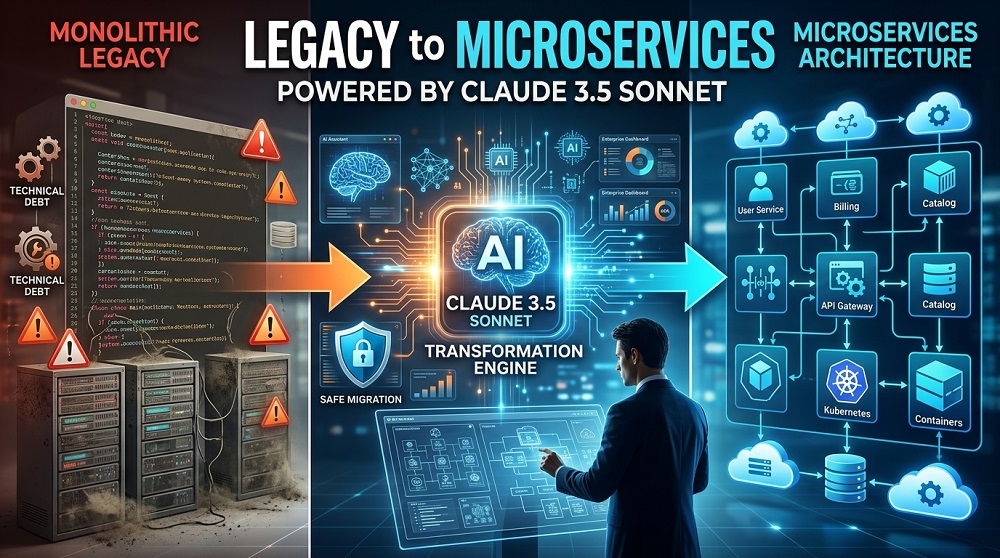
How Enterprise Architects Use Claude 3.5 Sonnet to Safely Migrate Monolithic Legacy Code to Microservices
If you work in enterprise software, you already know the pain. That massive, old codebase sitting in production for 10, maybe 15 years. Nobody fully understands it anymore. The original developers are gone. The documentation is either missing or completely outdated. And yet, the business depends on it every single day.
So what do you do?
More and more enterprise architects are turning to AI, specifically Claude 3.5 Sonnet, to help them break apart these legacy monoliths and move toward a modern MICROSERVICES architecture. And the results are genuinely interesting.
This post walks through HOW they are doing it, what works, what to watch out for, and why Claude 3.5 Sonnet specifically is becoming the tool of choice for this kind of work.
What is the Problem with Legacy Monolithic Code?
Before we get into the AI side of things, lets be clear about the challenge.
A MONOLITHIC application is one where all the components, user interface, business logic, data access, are packed into a single deployable unit. In the early days of software development, this made sense. Simpler to build, simpler to deploy.
But over time these systems grow. Features get added. Shortcuts get taken. Technical debt piles up. Eventually you end up with what developers call “spaghetti code,” where everything is tangled together and touching one part of the system can break something completely unrelated.
The business wants speed. The development team wants clean architecture. But migrating this to microservices without breaking things is EXTREMELY difficult.
Some of the most common problems architects face include:
- Hidden dependencies that nobody documented
- Shared databases that multiple modules write to simultaneously
- Unclear business domain boundaries
- Missing or outdated test coverage
- Risk of downtime during migration
This is exactly where Claude 3.5 Sonnet steps in.
Why Claude 3.5 Sonnet Specifically?
There are other AI tools out there. So why are enterprise architects gravitating toward Claude 3.5 Sonnet for this particular job?
A few reasons.
First, the CONTEXT WINDOW. Claude 3.5 Sonnet can handle very large amounts of code in a single session. Legacy codebases are big. You need an AI that can actually read and understand significant portions of the code at once, not just a few hundred lines.
Second, the REASONING CAPABILITY. Migration is not just a technical task. It requires understanding business logic, data flows, service boundaries, and risk. Claude 3.5 Sonnet is particularly strong at structured reasoning and explaining its thought process, which is important when you need to justify decisions to stakeholders.
Third, SAFETY. Anthropic built Claude with a focus on being honest about what it does and doesn’t know. In a migration project, you absolutely do not want an AI that confidently hallucinates architectural decisions. Claude tends to flag uncertainty, which is what you want.
And if you are already using AI tools for image generation or video generation on platforms like VeoAI Free, you know the difference quality makes. The same principle applies here.
How Enterprise Architects Are Actually Using It
Lets get practical. Here is the general workflow that experienced architects are using.
Step 1: Codebase Analysis and Domain Mapping
The first thing Claude 3.5 Sonnet does is help the team UNDERSTAND what they actually have. Architects feed portions of the codebase into Claude and ask it to:
- Identify distinct functional areas
- Map dependencies between modules
- Highlight tightly coupled code
- Suggest potential domain boundaries based on business logic
This is not guesswork. Claude reads the actual code and produces structured analysis. Architects then review this output and refine it using their own business knowledge.
Step 2: Identifying Service Boundaries
This is the most CRITICAL step and also the one where most migrations fail.
Cutting the monolith in the wrong places creates “distributed monolith,” which is arguably worse than the original problem. You get all the complexity of microservices with none of the benefits.
Claude 3.5 Sonnet helps by applying domain-driven design (DDD) principles to identify bounded contexts. Architects give Claude the business requirements alongside the code, and Claude helps identify where natural service boundaries exist.
A typical prompt might look like this:
“Here is our order processing module. Based on the business logic and dependencies, suggest how we might split this into independent services. Explain your reasoning and flag any high-risk coupling points.”
Claude will produce a clear, reasoned response that the team can debate and refine.
Step 3: Dependency Risk Assessment
Before touching anything in production, architects use Claude to build a RISK MAP.
| Risk Category | Description | Claude’s Role |
|---|---|---|
| Shared Database Tables | Multiple modules reading/writing same tables | Identifies shared data structures and suggests data ownership strategies |
| Circular Dependencies | Module A depends on B, which depends on A | Flags circular reference chains in code |
| Implicit Contracts | Functions called without clear interfaces | Documents hidden API contracts |
| State Management | Shared in-memory state across modules | Highlights stateful components that complicate extraction |
| External Integrations | Third-party APIs tied to specific modules | Maps external dependencies to business domains |
This table alone can save weeks of manual discovery work.
Step 4: Generating Migration Plans
Once boundaries are defined and risks are mapped, Claude 3.5 Sonnet helps generate a PHASED MIGRATION PLAN. This usually follows the strangler fig pattern, where new microservices gradually replace parts of the monolith while it stays running.
Claude helps draft:
- Which service to extract first (usually least risky, most isolated)
- What data migration strategy to use
- How to implement feature flags to route traffic incrementally
- What rollback procedures to prepare
- How to write integration tests for the new service boundaries
The key word here is DRAFT. Claude produces the starting point. Human architects review, challenge, and refine.
Step 5: Code Refactoring Assistance
Now comes the actual coding work. Claude 3.5 Sonnet can help developers:
- Refactor tightly coupled code into loosely coupled modules
- Write new service interfaces and API contracts
- Generate boilerplate for new microservices
- Convert existing business logic into service-appropriate structures
- Write unit tests for extracted components
This is not a one-shot process. Teams iterate with Claude continuously throughout the migration, asking it to review specific code sections, suggest improvements, and check for edge cases.
Safety Practices That Architects Follow
Using AI for migration does not mean handing over control. The architects doing this successfully follow strict SAFETY PROTOCOLS.
Never migrate without tests first. Before extracting any module, write comprehensive tests for its current behavior. Claude can help generate these tests. If the tests pass before and after extraction, you have confidence the behavior is preserved.
Always use feature flags. New services go behind feature flags so traffic can be routed incrementally. If something breaks, roll back immediately.
Review every AI suggestion. Claude’s output is a starting point, not a final answer. Every architectural decision must be reviewed by experienced humans who understand the business context.
Document as you go. Claude is excellent at generating documentation. Use it. Legacy systems fail partly because nobody documented them. Dont make the same mistake with your new microservices.
Run parallel for a period. Keep the old monolith running alongside new services for a period. Compare outputs. Only decommission the old code when confidence is high.
Real-World Complexity Claude Handles Well
Some of the more interesting use cases architects report include:
Database decomposition. This is one of the hardest parts of any microservices migration. Claude helps identify which tables belong to which bounded context and suggests strategies like database-per-service or event sourcing to separate data ownership.
Event-driven architecture design. When services need to communicate, Claude helps design event schemas and message contracts using patterns like CQRS (Command Query Responsibility Segregation) and event sourcing.
API gateway design. As the monolith breaks apart, something needs to handle routing, authentication, and rate limiting. Claude helps architects design API gateway configurations.
Legacy language translation. Some old systems are written in COBOL, older versions of Java, or proprietary languages. Claude can help translate business logic from legacy languages into modern equivalents, making the migration more manageable.
If you’re exploring other AI-powered tools for your workflow, including tools for generating visual content, check out what’s available at VeoAI Free’s image and video generation tools, where you can experiment with AI capabilities across different domains.
Common Mistakes to Avoid
Even with Claude helping, migrations can go wrong. Here are the mistakes experienced architects warn against.
Migrating too fast. The strangler fig pattern exists for a reason. Rushing to extract everything at once is a recipe for disaster.
Ignoring the human factor. Developers need to understand the new architecture, not just implement it. Make sure the team is learning alongside the tools.
Trusting AI output blindly. Claude is a reasoning assistant, not an oracle. Every output needs human validation, especially for critical business logic.
Skipping the domain analysis phase. Teams that jump straight to “lets extract this module” without proper domain mapping almost always regret it.
Not planning for data migration. Data is often the hardest part. Plan for it explicitly from day one.
Who Benefits Most From This Approach?
Not every organization is in the same position. This approach works especially well for:
- Financial services firms with large, decades-old transactional systems
- Healthcare organizations with complex data models and strict compliance requirements
- Retail enterprises with monolithic e-commerce platforms that need to scale independently
- Government agencies modernizing legacy infrastructure without service disruption
The common thread is that these are organizations where the cost of getting migration wrong is HIGH, and where having a structured, AI-assisted approach reduces the risk of catastrophic failure.
What Claude 3.5 Sonnet Cannot Do
Lets be honest about limitations too.
Claude cannot RUN your code. It analyzes and generates code but does not execute it. You still need your development pipeline to test and validate.
Claude does not have access to your live systems unless you explicitly paste code or configuration into the conversation. It works with what you give it.
Claude can make mistakes, particularly with very large and highly complex codebases where the context becomes too large for a single session. Teams handle this by breaking the codebase into logical sections and analyzing them in focused sessions.
And Claude cannot replace experienced software architects. It amplifies them. The human judgment about business priorities, risk tolerance, and organizational constraints is irreplaceable.
Final Thoughts
Legacy modernization is one of the hardest challenges in enterprise software. It is risky, expensive, and slow when done manually. But done well, it unlocks agility, scalability, and reduced operational costs that transform the business.
Claude 3.5 Sonnet is becoming a genuine tool in the enterprise architect’s toolkit, not as a replacement for human expertise, but as a force multiplier that helps teams analyze faster, plan better, and code more safely.
The teams seeing the best results are the ones who treat Claude as a highly capable COLLABORATOR, one that reads the code, reasons about the architecture, and surfaces risks that humans might miss, while keeping experienced architects firmly in the decision-making seat.
Is your organization dealing with a monolithic legacy system? The question isn’t whether to modernize. Its how to do it without breaking what already works. And increasingly, the answer involves AI assistance like Claude 3.5 Sonnet.
Want to explore more AI tools that can support your digital transformation workflows? Visit VeoAI Free to see what’s possible with modern AI capabilities across different use cases, from code assistance to visual content generation.