

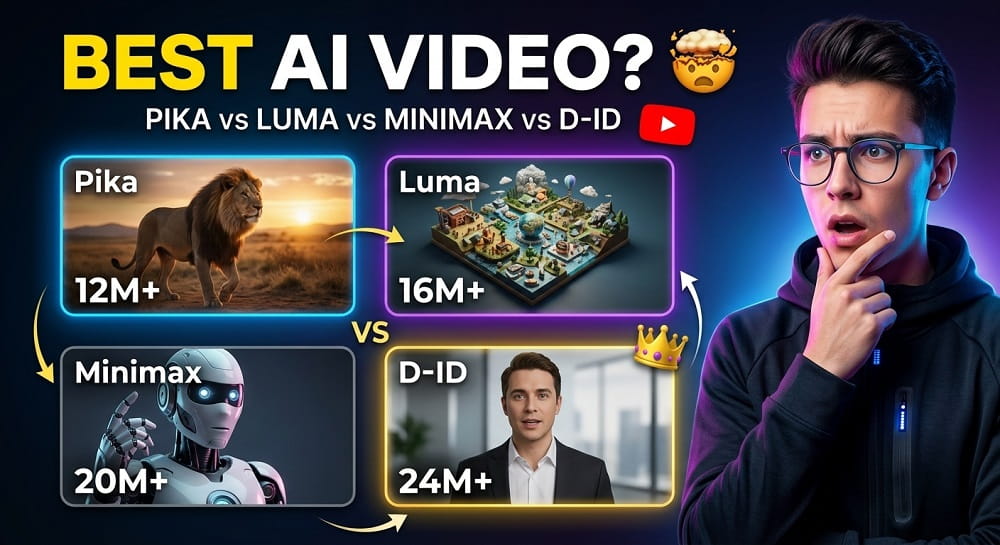
AI video generation has become one of the most talked about topics in the tech world right now. Everyone wants to know which tool gives the BEST results without spending a lot of money. So today, we are going to do a full comparison of four very popular AI video generator tools: Pika, Luma AI, Minimax, and D-ID.
Each of these tools has something unique to offer. But which one is actually worth your time? Let us break it all down.
Quick Overview of Each Tool
Before we go deep into the comparison, lets have a quick look at what each of these platforms actually do.
- Pika is a text-to-video and image-to-video AI tool that is known for its smooth animations and creative video styles.
- Luma AI (also known as Luma Dream Machine) generates high quality, realistic videos from text prompts with impressive motion and detail.
- Minimax is a Chinese AI company that offers a powerful video generation model called Hailuo AI, which has gained massive attention for its cinematic quality.
- D-ID is mostly focused on talking avatar videos. You can upload a photo and make it speak with AI voice. Very useful for presentations and digital humans.
You can explore more AI video tools by visiting our full list of AI Video Generators available right now.
Feature by Feature Comparison
Now, lets compare these four tools based on the most important features that users actually care about.
| Feature | Pika | Luma AI | Minimax (Hailuo) | D-ID |
|---|---|---|---|---|
| Text to Video | Yes | Yes | Yes | Limited |
| Image to Video | Yes | Yes | Yes | Yes (Photo Talking) |
| Talking Avatar | No | No | No | Yes (Main Feature) |
| Video Length | Up to 10 sec | Up to 10 sec | Up to 6 sec | Depends on plan |
| Free Plan | Yes | Yes | Yes | Yes (Limited) |
| Video Quality | Very Good | Excellent | Excellent | Good |
| Best Use Case | Creative Clips | Cinematic Videos | Realistic Motion | Presentations |
Video Quality: Who Wins?
This is probably the MOST important question for most users. How good does the video actually look?
Luma AI and Minimax both produces very realistic and cinematic quality videos. The motion is smooth, the lighting looks natural, and the details are impressive. If you are making a professional video or a short film style clip, these two are hard to beat.
Pika on the other hand is great for creative and stylized content. Its outputs looks very polished and the tool gives you more control over how the video should look and feel. Its a better choice if you want artistic outputs rather than hyper realistic ones.
D-ID gives decent quality for what it does. But it is not really competing in the same space as the other three when it comes to general video generation. Its main strength is in making photos talk, not generating cinematic videos.
Ease of Use
Is it easy to use? Yes, mostly. All four platforms are designed with beginners in mind. But there is still a difference in how smooth the experience feels.
- Pika has a very clean and simple interface. Writing a prompt and generating a video takes just a few clicks.
- Luma AI is also easy to use and the Dream Machine interface is quite straightforward. No technical skills needed.
- Minimax (Hailuo AI) is similarly simple, though being a newer platform, some users find the interface slightly less polished than Luma or Pika.
- D-ID has a unique workflow since its built around avatars and presentations. It takes a little bit more time to understand but its not complicated at all once you get started.
Pricing: Which One is More Affordable?
Let us talk about money. Nobody wants to overpay for a tool, right?
| Tool | Free Plan | Starting Paid Price | Credits System |
|---|---|---|---|
| Pika | Yes | Around $8/month | Yes |
| Luma AI | Yes (30 free generations) | Around $29.99/month | Yes |
| Minimax (Hailuo) | Yes | Very affordable credits | Yes |
| D-ID | Yes (20 free credits) | Around $5.99/month | Yes |
If budget is a concern, D-ID and Pika are the more affordable starting options. Luma AI is on the pricier side but the quality justifies it for professional use. Minimax is surprisingly affordable for the quality it delivers.
Best Use Cases for Each Tool
Not every tool is made for every purpose. Here is where each one really SHINES.
Pika: Best for Creative and Stylized Video Clips
If you are a content creator who want stylized, eye-catching short videos for social media, Pika is a great choice. Its cinematic effects and video editing features makes it stand out from the crowd. You can add effects like explosions, slow motion, and style changes to existing videos too.
Luma AI: Best for Cinematic and Realistic Videos
Luma AI is the go-to choice when you need HIGHLY realistic videos with natural motion. The quality is on par with some of the best models out there. If you are doing product videos, short films, or anything that needs to look real, Luma AI should be your first pick.
Minimax (Hailuo AI): Best for Smooth Motion and Storytelling
Minimax’s Hailuo AI model is particularly good at generating videos that have smooth and consistent motion. Its great for storytelling style videos and the output often looks like a real movie scene. For those who wants Hollywood-like clips without the Hollywood budget, Minimax is worth trying.
D-ID: Best for Talking Avatars and Presentations
D-ID is in a class of its own when it come to talking avatar videos. If you need a digital human to present your content, D-ID is the BEST tool for the job. Its widely used for corporate training videos, marketing presentations, and educational content.
Which One Should You Actually Use?
Okay so after going through all of this, which tool should you pick? Here is a simple answer.
- If you want the BEST overall video quality, go with Luma AI or Minimax.
- If you want creative and stylized content, pick Pika.
- If you want talking avatar videos or digital human content, use D-ID.
- If you are on a tight budget, start with Pika or D-ID free plans.
The truth is, there is no single WINNER here. Each tool serves a different purpose and different type of user. The best strategy is to try the free plans of each one and see which fits your workflow the most.
Also, if you are interested in generating still images with AI before turning them into videos, make sure to check out our collection of AI Image Generators as well. Combining image generation with video generation can really take your content to the next level.
Final Thoughts
AI video generation is evolving incredibly fast. What was impressive six months ago is now considered basic. Tools like Luma AI, Minimax, Pika, and D-ID are all pushing the boundaries of what is possible with just a text prompt or a single image.
For most general users, Luma AI and Minimax currently offers the best quality output. But Pika is not far behind and is a very strong choice for creative professionals. And if avatar-based content is your thing, D-ID simply has no real competition in that specific category.
Try them all. Most of these platforms offers FREE credits to get started. You have nothing to lose by testing each one and deciding for yourself which tool delivers the results that matters most to your work.