

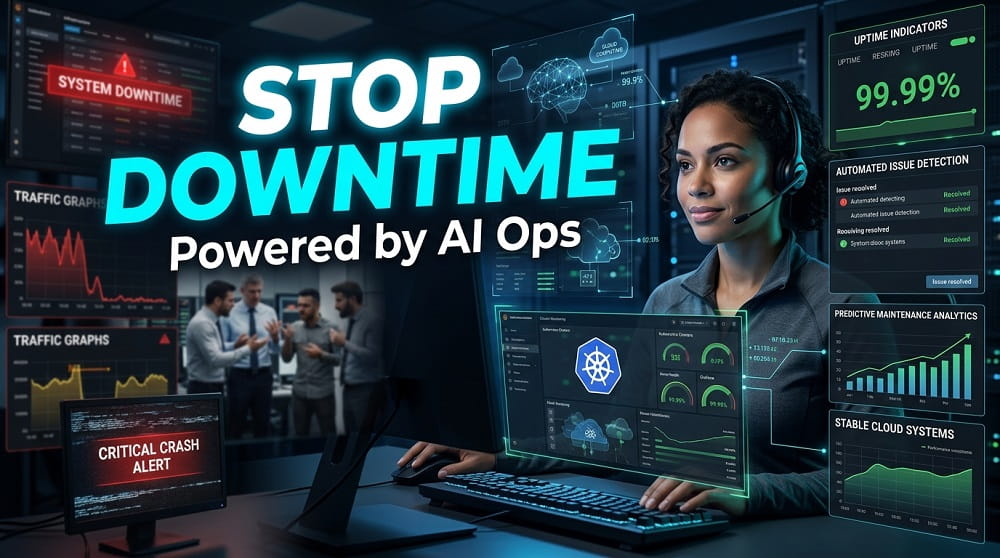
System downtime is not just a technical inconvenience. It is a BUSINESS CRISIS. Every minute a production system goes down, companies lose revenue, customers lose trust, and engineering teams lose sleep. The traditional approach to handling outages has always been reactive, meaning you wait for something to break and then you fix it. But in 2025, that model is simply not good enough anymore.
This is exactly why so many modern engineering teams are shifting to AI OPS, which stands for Artificial Intelligence for IT Operations. Its a framework that uses machine learning, real-time analytics, and intelligent automation to predict, detect, and resolve infrastructure problems before they ever reach the end user. The question is, how does it actually work and why are the best engineering teams in the world betting on it?
What AI Ops Actually Means in Practice
A lot of people hear the term AI OPS and think its just a fancier monitoring dashboard. Its not. Traditional monitoring tools alert you when something has already gone wrong. AI Ops tools are designed to identify the CONDITIONS that lead to failure, hours or even days before the failure actually happens.
At its core, AI Ops combines three things together. First, it ingests MASSIVE VOLUMES of operational data, things like logs, metrics, traces, events, and alerts from every layer of the system stack. Second, it applies machine learning models to find patterns in that data that would be impossible for a human to detect manually. Third, it takes automated or semi-automated action based on what it finds, whether that is alerting an engineer, triggering a scaling event, or rolling back a faulty deployment.
According to industry research, organizations using AI Ops report up to a 60% reduction in mean time to resolution (MTTR) and a significant drop in the number of major incidents reaching production environments.
The Real Cost of Downtime That Most Teams Underestimate
Before understanding why AI Ops matters, its worth understanding what downtime actually costs. Most engineering leaders focus on the direct revenue impact. But the real damage is broader then that.
- REVENUE LOSS: For e-commerce platforms, payment processors, and SaaS companies, even 10 minutes of downtime can mean thousands or millions in lost transactions.
- CUSTOMER CHURN: Users who experience repeated outages do not always come back. The trust damage is often permanent, especially in competitive markets.
- ENGINEER BURNOUT: On-call rotations that constantly respond to fire-fighting incidents are exhausting. Teams that spend most of their time reacting to problems have no time to build new features or improve systems.
- REPUTATIONAL DAMAGE: Public outages get noticed. Social media moves fast, and a single high-profile incident can define how the market sees your reliability for months afterward.
- COMPLIANCE RISK: For companies in regulated industries like finance or healthcare, system downtime can trigger SLA breaches and even regulatory penalties.
When you add all of this together, the case for PREDICTIVE INFRASTRUCTURE MANAGEMENT becomes very strong, very quickly.
How AI Ops Prevents Downtime: The Core Capabilities
Anomaly Detection at Scale
One of the most powerful things AI Ops does is detect ANOMALIES in system behavior, and it does this at a scale and speed that no human team can match. Modern distributed systems generate billions of log lines and metric data points every single day. No alert rule written by hand can possibly cover every failure pattern.
AI models trained on historical data learn what “normal” looks like for a given service, at a given time of day, under a given load. When behavior deviates from that baseline, even subtly, the system flags it. This catches things like memory leaks in their early stages, gradual database query degradation, or abnormal network latency that would otherwise go unnoticed until they cause a full outage.
Predictive Capacity Planning
Can you predict when your infrastructure will run out of capacity? With traditional tools, probably not. With AI Ops, you can.
By analyzing usage trends, seasonal patterns, and growth trajectories, AI Ops platforms generate CAPACITY FORECASTS that tell engineering teams when they need to scale up resources, before demand actually hits. This prevents the kind of infrastructure collapse that happens when a product goes viral or a marketing campaign drives an unexpected traffic spike.
Intelligent Alert Correlation
One of the biggest pain points for on-call engineers is ALERT FATIGUE. When something goes wrong in a complex system, it often triggers dozens or even hundreds of alerts simultaneously, most of which are symptoms of the same root cause. Sifting through all of that noise to find the actual problem is slow and stressful.
AI Ops platforms solve this by correlating alerts automatically. Instead of receiving 200 separate notifications, an engineer receives one grouped incident with a probable root cause and a suggested remediation path. The signal-to-noise ratio improves dramatically, and response time drops accordingly.
Automated Remediation
The most advanced AI Ops implementations go beyond detection and alerting. They actually FIX PROBLEMS autonomously. When a model identifies a known failure pattern, it can trigger a pre-defined runbook automatically, things like restarting a stuck service, clearing a cache, rerouting traffic, or rolling back a recent deployment.
This is where AI Ops truly starts to deliver on its promise of stopping downtime before it happens, because in many cases, the system heals itself before a human even becomes aware there was a problem.
AI Ops vs. Traditional Monitoring: A Direct Comparison
| Capability | Traditional Monitoring | AI Ops Platform |
|---|---|---|
| Incident Detection | Threshold-based alerts, reactive | Anomaly detection, predictive signals |
| Alert Volume | High noise, many false positives | Correlated, grouped, low noise |
| Root Cause Analysis | Manual investigation by engineers | Automated probable cause identification |
| Capacity Planning | Manual estimation, spreadsheets | AI-driven forecasting and auto-scaling triggers |
| Incident Response | Human-only, on-call rotation | Automated remediation for known patterns |
| Data Volume Handled | Limited by rule complexity | Billions of events per day, processed in real-time |
| Learning Over Time | Static rules, manual updates | Continuous model retraining and improvement |
Which Engineering Teams Are Adopting AI Ops Fastest
Its not just the hyperscalers like Google and Amazon that are using AI Ops. The adoption is happening across industries and company sizes. That said, some sectors are moving faster than others.
- FINTECH AND BANKING: Financial services companies have zero tolerance for downtime. Payment processing systems, trading platforms, and banking apps are using AI Ops to maintain the FIVE NINES of availability that their customers and regulators demand.
- E-COMMERCE AND RETAIL: Companies with high traffic variability, particularly around events like Black Friday or flash sales, use AI Ops to predict load spikes and pre-scale infrastructure before demand arrives.
- HEALTHCARE TECHNOLOGY: Telehealth platforms and hospital information systems cannot afford outages. AI Ops provides the early warning layer that keeps critical systems running when they are needed most.
- GAMING AND STREAMING: Platforms where user experience is everything rely on AI Ops to catch latency degradation, CDN issues, and backend bottlenecks before users start complaining on social media.
- SAAS COMPANIES: For subscription businesses, uptime is literally part of the product. AI Ops is becoming a core part of how SaaS engineering teams deliver on their SLA commitments.
The Tools Leading Engineering Teams Are Using
The AI Ops market has matured considerably over the last three years. Several platforms have emerged as clear leaders, each with different strengths depending on the size and complexity of the engineering organisation.
| Platform | Best Known For | Typical User |
|---|---|---|
| Dynatrace | Full-stack observability with AI-powered root cause analysis | Large enterprise engineering teams |
| Datadog | Unified monitoring, APM, and anomaly detection | Mid-size to large tech companies |
| New Relic | Real-time telemetry and intelligent alerting | SaaS and cloud-native teams |
| PagerDuty | Intelligent incident response and on-call management | Teams with complex on-call structures |
| Moogsoft | AI-driven alert correlation and noise reduction | High-volume operations teams |
Why Human Oversight Still Matters in AI Ops
Its tempting to think that AI Ops means engineering teams can just sit back and let the machines handle everything. That is not how the best teams approach it. HUMAN JUDGMENT still plays a critical role, especially in a few key areas.
Novel failure modes, those that the AI has never seen before, still require experienced engineers to diagnose and resolve. Business context, like knowing that a certain service can be degraded during off-peak hours but not during a product launch, is something humans provide. And the continuous improvement of the AI models themselves requires engineers to review decisions, flag false positives, and help the system learn over time.
The healthiest AI Ops implementations treat the system as a FORCE MULTIPLIER for the engineering team, not a replacement for it. The AI handles the high-volume pattern recognition. The humans handle the judgment calls.
How AI Content Tools Are Helping Engineering Teams Communicate Better
There is another dimension to modern engineering operations that often gets overlooked, and that is COMMUNICATION. When incidents happen, or when engineering teams want to train their organisations on new operational processes, they need to explain complex technical concepts clearly to non-technical stakeholders.
This is where AI-powered content generation tools are making a real difference. Teams are using tools like the Veo Video Generator to create explainer videos around their AI Ops workflows, incident post-mortems, and system architecture changes that would previously have required a dedicated video production team. Instead of a dense written runbook, new engineers get a clear, visual walkthrough of how the systems work.
Similarly, converting architecture diagrams, dashboard screenshots, and monitoring visualisations into dynamic video content is now straightforward with tools like the Photo and Image to Video Generator. For engineering teams building internal knowledge bases or producing technical content for their developer communities, this kind of tool dramatically reduces the time and cost of producing PROFESSIONAL VISUAL CONTENT.
What to Consider Before Implementing AI Ops
If your team is considering moving toward AI Ops, there are a few things worth thinking through before you start.
- DATA QUALITY FIRST: AI Ops models are only as good as the data they are trained on. If your logging and metrics infrastructure is inconsistent or incomplete, that is the first thing to fix. Garbage in, garbage out applies here just as much as anywhere else.
- START NARROW: Do not try to AI-ify your entire operations stack in one go. Pick one high-pain area, whether that is alert fatigue, capacity planning, or anomaly detection, and prove value there first before expanding.
- INVEST IN TRAINING: Your engineering team needs to understand how the AI models work and what they are optimising for. Engineers who distrust the system will work around it, which defeats the purpose.
- DEFINE SUCCESS METRICS: Before you implement, agree on what success looks like. MEAN TIME TO DETECTION, MEAN TIME TO RESOLUTION, and number of customer-impacting incidents are good starting points.
- PLAN FOR MODEL DRIFT: Systems change over time. The AI models need to be retrained regularly to reflect new services, architectural changes, and evolving traffic patterns.
Final Thoughts
The shift from reactive incident management to PREDICTIVE OPERATIONS is one of the most significant changes happening in engineering right now. Teams that embrace AI Ops are not just reducing downtime. They are fundamentally changing how they work, freeing engineers from constant fire-fighting and giving them the space to build, improve, and innovate.
Downtime will never be completely eliminated. But with AI Ops in place, the best engineering teams are getting remarkably close to catching every problem before it becomes one. That is not a small thing. In a world where digital services are expected to be always on, it might just be the most important capability an engineering team can build.