

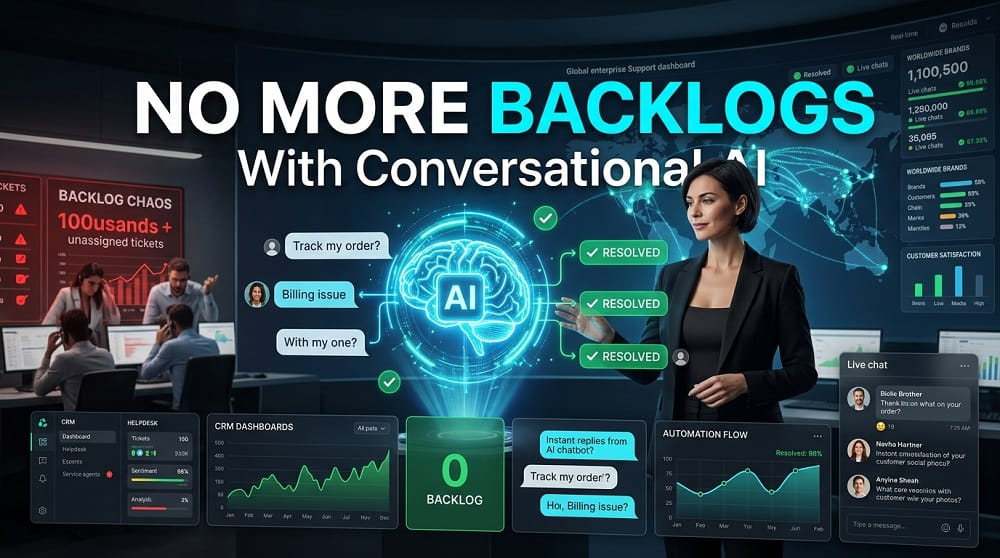
Customer support has always been one of the most resource-intensive parts of any business. Thousands of tickets, long wait times, frustrated customers, and overloaded agents. Sound familiar? It probably does. And for global brands handling millions of queries per month, the problem is not just inconvenient, it is EXPENSIVE.
So what is the solution? More agents? Bigger call centers? Not anymore. The answer that brands are turning to right now is CONVERSATIONAL AI. And the results, honestly, are hard to ignore.
This post breaks down exactly how global companies are using conversational AI to cut through support backlogs, what tools they are using, and what this means for the future of customer experience.
What is Conversational AI, Really?
Let us be clear about what we are talking about. Conversational AI is not just a basic chatbot that says “press 1 for billing.” It is a far more advanced system that understands NATURAL LANGUAGE, remembers context within a conversation, and can actually resolve issues without handing the user off to a human every five minutes.
It includes technologies like:
-
- Large Language Models (LLMs) that understand and generate human-like responses
- Natural Language Processing (NLP) for understanding intent and sentiment
Voice AI systems
- for phone and audio-based support channels
- Omnichannel integration that connects chat, email, WhatsApp, and social in one place
These systems can handle questions, complaints, refund requests, order tracking, technical troubleshooting and a lot more, often without any human involvement at all.
The Scale of the Problem Global Brands Are Facing
Why is this so urgent? Because support backlogs are growing faster than teams can scale. Consider this:
| Industry | Average Tickets Per Month | Average Resolution Time (Before AI) | Customer Satisfaction Rate |
|---|---|---|---|
| E-commerce | 500,000+ | 48-72 hours | 61% |
| Telecom | 1.2 million+ | 3-5 days | 54% |
| Banking & Finance | 800,000+ | 24-48 hours | 58% |
| Travel & Hospitality | 300,000+ | 72 hours | 56% |
| SaaS & Tech | 200,000+ | 36-60 hours | 63% |
These numbers show a clear pattern. High volume, slow resolution, and customers who are not particularly happy about it. That is the backlog problem in numbers.
How Global Brands Are Actually Deploying Conversational AI
This is where it gets interesting. Different brands are using conversational AI in different ways depending on their industry and their specific pain points. Here are the most common deployment strategies being used right now.
1. First-Line Resolution Bots
The most straightforward use case. A conversational AI bot handles the FIRST interaction with every customer. It understands the issue, pulls relevant data from backend systems (like order databases or CRM tools), and resolves common queries instantly.
Companies like Amazon and Shopify merchants have deployed this approach heavily. Order tracking, return requests, password resets, and account queries are resolved in seconds, not days. The human team only steps in when the AI cannot handle something, which is a much smaller portion of total tickets.
2. Intelligent Ticket Triage
Not every query can be resolved by AI. But what AI can do is READ every incoming ticket, categorize it by urgency and type, and route it to the right team or agent automatically. This alone cuts resolution times dramatically because tickets are no longer sitting in a generic inbox waiting for a human to manually sort through them.
Banks and insurance companies have been particularly aggressive about this. A complaint about a fraudulent transaction, for example, gets flagged as HIGH PRIORITY and routed to the fraud team instantly rather then sitting in a queue for two days.
3. 24/7 Multi-Language Support
Global brands operate across time zones and language barriers. Hiring agents for every language, every shift is simply not practical. Conversational AI solves this completely.
AI systems can now respond in over 100 languages with near-native fluency. A customer in Germany, Japan, or Brazil gets the same quality of support at 3am that a customer in New York gets at noon. No delays, no “our team is currently offline” messages.
4. Proactive Support Outreach
Here is something most people don’t think about. Conversational AI doesn’t just react to queries. It can ANTICIPATE them. If a brand knows a product batch has a defect, or a flight is about to be delayed, the AI can proactively reach out to affected customers BEFORE they even submit a ticket.
Airlines like KLM have built entire proactive messaging systems around this. Customers receive updates, rebooking options, and support before they even realize they need it. Result? Ticket volume drops significantly.
5. AI-Assisted Human Agents
This one is often overlooked. Not every deployment is about replacing human agents. Some brands use conversational AI as a COPILOT for their support teams. The AI listens to a customer conversation in real time and suggests responses, pulls relevant knowledge base articles, and flags sentiment changes.
This makes human agents significantly faster and more accurate. Response times shrink. Customer satisfaction goes up. And agents don’t burn out as quickly because routine cognitive work is handled for them.
Real World Examples Worth Knowing
Let us look at a few actual cases to ground this in reality.
- H&M deployed an AI-powered chatbot that handles over 70% of customer queries without human intervention. The chatbot manages returns, size queries, and order tracking across 74 markets.
- Bank of America’s virtual assistant Erica has handled over 1.5 billion client interactions since launch, resolving everything from balance queries to budgeting advice.
- Sephora uses conversational AI on both their website and messaging apps to handle product recommendations and order support, reducing average handling time by nearly 40%.
- Vodafone deployed TOBi, their AI support assistant, across multiple countries. It now handles millions of queries monthly in local languages, dramatically reducing call center load.
These aren’t small experiments. These are full scale deployments at GLOBAL level, and the impact on backlogs has been transformative.
The Role of AI-Generated Content in Customer Support Ecosystems
Conversational AI is just one piece of the puzzle. Brands that are winning at customer support are also using AI to CREATE BETTER SUPPORT RESOURCES. Video tutorials, product explainers, onboarding guides and visual FAQs are becoming standard parts of support infrastructure.
This is where tools like the Veo AI Video Generator become relevant. Brands can produce high-quality explainer videos at scale to reduce repetitive support queries. When a customer can watch a 60-second video that shows exactly how to set up a product or resolve an issue, they often don’t need to contact support at all. The ticket never gets created in the first place.
Similarly, visual content created through the Photo and Image to Video Generator can help brands transform static product images into dynamic visual guides, making self-service support more engaging and actually useful for customers.
Key Benefits of Conversational AI for Support Teams
| Benefit | Impact |
|---|---|
| 24/7 Availability | No downtime, no shift gaps, global coverage at all hours |
| Instant Response | Zero wait time for customers on common queries |
| Massive Cost Reduction | Up to 60-70% reduction in support costs for high-volume teams |
| Consistent Quality | AI doesn’t have bad days, doesn’t give inconsistent answers |
| Scalability | Can handle 10x traffic spikes without hiring a single agent |
| Data & Insights | Every interaction is logged and analysed for product and service improvement |
What Brands Get Wrong When Deploying Conversational AI
It would not be a fair article if we didn’t mention the mistakes. Because companies do get this wrong, and when they do, customers notice.
- Deploying AI without proper training data leads to irrelevant or incorrect responses that frustrate customers more than a slow human would
- Hiding the escalation path to a human agent is a common mistake. Customers need to know they can reach a real person if they need to
- Ignoring emotional context is a big one. AI that responds to an angry or distressed customer with a cheerful, robotic reply causes serious brand damage
- Not integrating with backend systems means the AI cannot actually access order data, account info, or history, making it useless for real resolution
The brands that get conversational AI RIGHT are the ones that treat it as an ongoing product, not a one-time deployment. They test it constantly, gather feedback, and keep improving.
What Does This Mean for the Future?
Here is the honest truth. Conversational AI is not a trend that will fade. It is becoming INFRASTRUCTURE. Just like brands once had to build websites and then mobile apps, they are now building AI-powered support layers as a core part of their customer experience strategy.
The brands that move fast here will have a significant advantage. Lower costs, happier customers, faster resolution, and better data for product decisions. The ones that wait will fall behind, not just in efficiency, but in customer loyalty.
The technology is no longer experimental. It is proven, it is scalable, and it is here. Global brands are not deploying conversational AI because it is trendy. They are deploying it because the backlog problem is real, the cost of not solving it is high, and AI is the only solution that scales at the speed modern business demands.
Final Thoughts
So where does your brand stand on this? Are you still relying on manual ticket sorting, generic chatbots, and overwhelmed agents? Or are you building a support system that can handle the volume of the future?
The global brands that have deployed conversational AI at scale are not just cutting backlogs. They are fundamentally changing the relationship between their business and their customers. Faster, smarter, always on. That is the standard being set right now.
And for content teams that support these efforts with video, visual guides, and AI-powered media, tools like the Veo AI Video Generator are already helping brands create the kind of self-service content that reduces ticket volume before it even starts.