

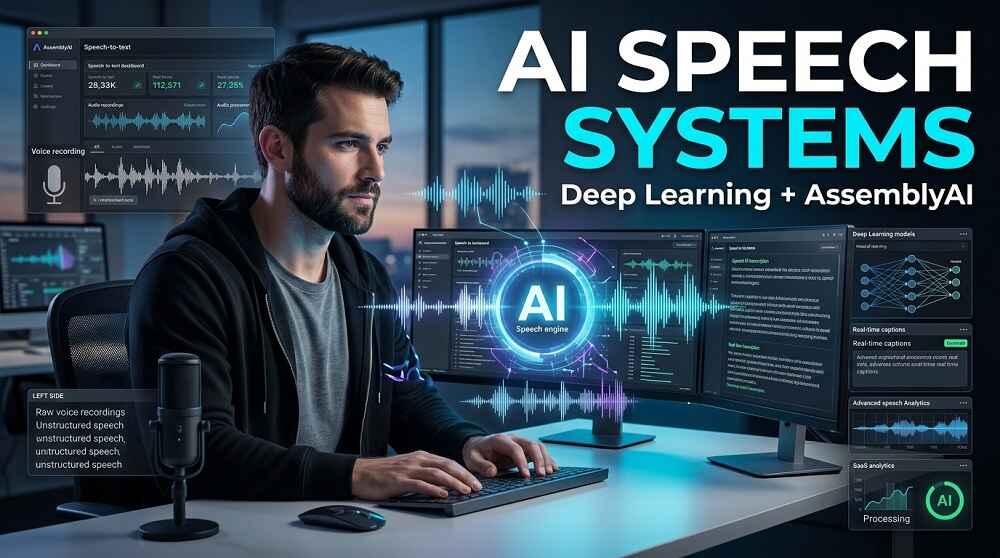
Speech technology has come a long way. Not too long ago, voice recognition was unreliable, slow, and mostly limited to controlled environments. Today, SaaS engineers are building PRODUCTION-GRADE speech systems that can transcribe, analyze, and understand human speech in real time. The question is, how exactly do they do it?
The answer, in most cases, comes down to two things: Assembly AI and deep learning architectures working together.
This post breaks down the technical approach SaaS teams use, the models involved, and why Assembly AI has become a go-to choice for developers who want accurate, scalable speech capabilities without building everything from scratch.
What Is Assembly AI and Why Do Engineers Choose It?
Assembly AI is a speech-to-text and audio intelligence API built specifically for developers. It offers transcription, speaker diarization, sentiment analysis, content moderation, and a lot more through a single API endpoint.
Why do SaaS teams prefer it? Because it removes the need to train and maintain custom acoustic models, which is an enormous amount of work. Engineers can focus on their core product instead of tuning neural networks for phoneme recognition.
That said, understanding the deep learning systems UNDERNEATH Assembly AI helps engineers use it far more effectively, and in some cases, extend it with their own models.
The Deep Learning Foundation of Modern Speech Systems
Before we talk integration, let us understand the core architecture. Modern speech recognition systems are built on TRANSFORMER-based neural networks, often combined with techniques like Connectionist Temporal Classification (CTC) and attention mechanisms.
Here is a simplified view of the layers involved:
| Layer | Function |
|---|---|
| Feature Extraction | Converts raw audio to Mel spectrograms or MFCCs |
| Acoustic Model | Maps audio features to phoneme probabilities |
| Language Model | Applies linguistic context to improve word predictions |
| Decoder | Converts probabilities into final text output |
Each of these layers can be fine-tuned independently, which is exactly what advanced SaaS teams do when they need domain-specific accuracy, like for medical transcription or legal dictation software.
How SaaS Engineers Actually Integrate Assembly AI
The integration process is simpler than most people expect, but making it PRODUCTION-READY requires careful engineering.
Step 1: Audio Ingestion Pipeline
The first challenge is getting clean audio into the system. Engineers typically set up:
- A preprocessing layer to normalize audio levels and remove background noise
- Format conversion (most APIs prefer WAV or MP3 at 16kHz sample rate)
- Chunking logic for long-form audio, since real-time systems cannot wait for a full recording
Step 2: API Configuration
Assembly AI’s API is highly configurable. Engineers pick which features they actually need, and this matters for performance and cost.
{
  "audio_url": "https://yourapp.com/audio/session_001.mp3",
  "speaker_labels": true,
  "sentiment_analysis": true,
  "auto_chapters": false,
  "language_detection": true
}
Only enable what you need. Enabling every feature adds latency and cost, which adds up fast at scale.
Step 3: Webhook-Based Result Handling
For asynchronous transcription, engineers use webhooks rather than polling. This is a CRITICAL design decision. Polling every few seconds to check job status wastes resources and creates unnecessary API load.
A well-built SaaS system registers a callback URL, processes the result when Assembly AI sends it, and stores the transcript in a structured database immediately.
Deep Learning Fine-Tuning for Niche Domains
Here is something most tutorials skip. Assembly AI’s base model works well for general speech, but what about specialized vocabulary? A legal tech startup dealing with Latin legal terms or a medical SaaS handling clinical notes needs more precision.
SaaS engineers handle this in two ways:
Custom Vocabulary (Word Boost)
Assembly AI supports a feature called word boost, where you supply a list of domain-specific terms and the model increases the probability of recognizing them. It does not retrain the model, it just shifts the decoder’s attention.
"word_boost": ["habeas corpus", "myocardial infarction", "appellant", "deposition"]Fine-Tuning Auxiliary Models
For truly specialized use cases, teams build secondary NLP models that take Assembly AI’s raw transcript and run it through a fine-tuned BERT or RoBERTa model for entity extraction, intent classification, or error correction.
This approach is popular in customer service SaaS, where transcripts feed into support ticket classification systems automatically.
Real-Time Streaming Architecture
Batch transcription is straightforward. Real-time is harder. SaaS products like call center analytics or live captioning tools need sub-second latency.
Assembly AI supports real-time transcription via WebSockets. Here is how engineers structure the real-time pipeline:
- Audio capture on the client side (browser mic or phone call tap)
- Chunked PCM streaming over WebSocket to Assembly AI’s endpoint
- Partial result handling to display interim transcripts as the user speaks
- Final segment processing when silence is detected, triggering downstream logic
The key challenge here is handling PARTIAL TRANSCRIPTS gracefully. Early words in a phrase often get revised as the model receives more audio context. A good UI must handle text corrections without creating a jarring experience for the user.
Speaker Diarization: Knowing Who Said What
One of the most technically interesting features is speaker diarization. It answers the question: who is speaking, and when?
Assembly AI handles diarization through deep neural network models trained to distinguish speaker voice characteristics, pitch patterns, and acoustic signatures. The output tags each transcript segment with a speaker label.
{
  "text": "The contract expires next quarter.",
  "speaker": "A",
  "start": 4200,
  "end": 6800
}
SaaS applications use this for meeting summarization, interview analysis, and compliance recording in financial services. Pairing diarization with sentiment analysis gives teams a POWERFUL combination: you know not just what was said, but who said it, and how they felt when saying it.
Performance and Scaling Considerations
Building a speech system that works in a demo is easy. Making it work for 10,000 concurrent users is a different challenge.
SaaS engineers handling scale think about:
- Queue management: Audio jobs should go into a message queue (like SQS or RabbitMQ) before hitting the transcription API, preventing rate limit errors during traffic spikes
- Caching: If the same audio is submitted multiple times (which happens with shared recordings), cache the transcript by file hash to avoid redundant API calls
- Cost controls: Set hard limits on audio duration per user tier, since long recordings can create unexpected billing spikes
- Error handling: Network failures, malformed audio, and API timeouts need graceful degradation, returning a partial result or queuing for retry is far better than showing nothing
Assembly AI vs Building Your Own Model
Should a SaaS company use Assembly AI or build their own ASR system from scratch?
| Factor | Assembly AI | Custom Model |
|---|---|---|
| Time to production | Days | Months to years |
| Infrastructure cost | Pay per minute | High upfront + ongoing |
| Accuracy (general) | Very high | Depends on training data |
| Customization | Limited to API features | Full control |
| Maintenance burden | Low | Very high |
For 95% of SaaS products, Assembly AI wins. The only cases where building custom makes sense are: extremely high volume (millions of hours per month), highly unique languages or dialects not well represented in training data, or strict data residency requirements that prevent sending audio to external services.
Combining Speech AI With Generative Capabilities
The most cutting-edge SaaS engineers are not just transcribing audio. They are feeding those transcripts into large language models to generate summaries, action items, follow-up emails, and more.
If you are interested in how AI generation tools are being integrated into SaaS workflows, our post on AI video generation tools explores how platforms like Veo AI are being used for automated content creation. For teams building MULTIMODAL applications that combine voice input with visual AI outputs, understanding both sides of the stack is increasingly important.
Similarly, if your SaaS product involves generating media assets from AI-processed inputs, it is worth exploring AI image generation tools to understand how visual generation complements speech-driven pipelines.
Common Mistakes SaaS Engineers Make
A few patterns come up again and again that slow teams down or create bugs in production:
- Ignoring audio quality at the source: The best model in the world cannot fix a bad microphone. Set minimum quality requirements for input audio.
- Not handling language switching: Users in multilingual environments may switch languages mid-sentence. Assembly AI’s language detection helps, but engineers need to handle mixed-language edge cases explicitly.
- Underestimating transcript post-processing: Raw transcripts need formatting, punctuation correction, and entity tagging before they are useful in most product contexts.
- Skipping confidence scores: Assembly AI returns confidence values per word. Using these to flag low-confidence segments for human review dramatically improves quality in high-stakes applications.
The Future: End-to-End Neural Speech Systems
The field is moving fast. Current systems still separate acoustic modeling and language modeling into distinct components. The next generation of models, already appearing in research, handle everything END-TO-END in a single neural network. This reduces error accumulation across pipeline stages and enables more natural spoken language understanding.
Assembly AI has already moved in this direction with their Universal-1 model, which was trained on hundreds of thousands of hours of audio and shows significant improvements over older architectures, particularly on accented speech and noisy environments.
For SaaS engineers, this means the API will keep getting better without requiring any changes to your integration. But understanding the architecture underneath helps you make better product decisions today, and anticipate what becomes possible tomorrow.
Wrapping Up
Building advanced speech systems is no longer reserved for companies with massive ML research teams. With Assembly AI as the foundation and a solid understanding of the deep learning principles at play, a small SaaS engineering team can ship production-quality voice features in weeks.
The key is knowing when to use the API as-is, when to extend it with auxiliary models, and how to build the surrounding infrastructure that makes speech AI reliable and scalable. Master those three things, and you are well ahead of most teams building in this space.